You must have a solid understanding of the motorcycle world to be effective in marketing. Your marketing person’s efforts are the link between your motorcycle website and your target audience. As a result, your internet marketing and biker world experts must have both. Below is an article explaining the history of the term “biker.”
Let me start with information on the term “biker.” Over 120 years ago, it was first used by bicycle riders. Later, the same term was used to refer to “motorized bicycles.”
WWII and Modern Day “Bikers”
But what most people think of a biker today started after World War II. That stereotype is of a leather-clad, scruffy rider on a big-displacement Harley-Davidson or an old Indian motorcycle.
After troops returned from the War, they were, in some ways, finding their place in society. They also missed the intensity of the theater of War. Plus, the prices of motorcycles used in WWII were low, and the troops had cash. Because of these three items, many of them bought motorcycles.
Birth of the “American Biker”
In 1947, the “incident” occurred at the Hollister Motorcycle Rally. Now, I say “incident” because it was publicized as a full-on riot in the newspapers. Back then, newspapers and magazines delivered the news. And there were not many cameras; news stories could easily be blown out of proportion. Unfortunately, what the newspapers and magazines reported about what happened in Hollister was untrue.
Today, what happened in Hollister would be better called “bikers getting a little wild.” And yes, there were some fights. But the media made it sound like full-on mayhem and out-of-control riots. Also, some of the information went beyond mere exaggeration.
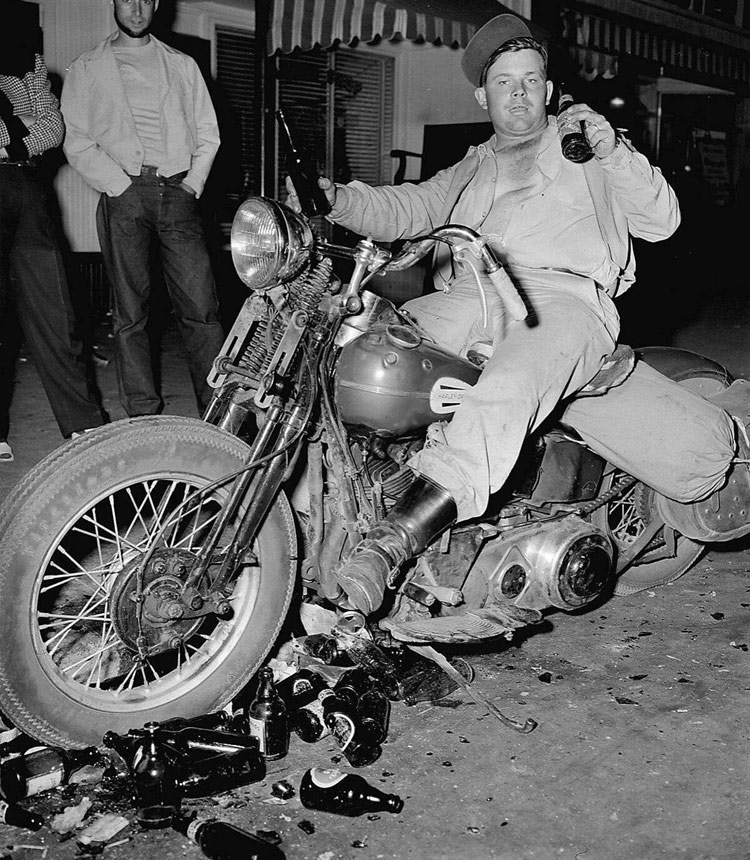
The classic picture of the biker (now known to be Eddie Davenport) is notably in Hollister’s streets. He is kicked back slightly awkwardly, sitting on a Harley, looking like he is drinking two beers with bottles all around the bike. But now it is known that this picture was staged. Even though the Hollister biker rally incident was misreported, it was significant. This is because it created the persona of the “American biker.”
Gypsy Tours & the Biker Mystique
From post-WWII to 1969, biker culture grew. One notable thing that helped keep it going was motorcycle rallies, often called “Gypsy tours.” Gypsy tours started as parties/get-togethers for riders to enjoy camaraderie, competitions, riding, and partying. One popular competition was the hillclimbs.
Back then, hillclimb motorcycles were closer to stock. Some were lightened by removing parts, and others had different tires or tires with chains, but the bikes looked stock, unlike most hill-climb motorcycles today.
Easyriders the Movie & Biker Persona
Then, in 1969, the movie Easyriders came out. Now, you’ve most likely seen the movie. And you most likely know how this was part of the biker life. In addition, it popularized choppers. Honestly, the impact of the Easyriders movie helped keep Harley in business for decades. In addition, the Easyriders movie also helped create the mystique of both Harleys and choppers.
Early-2000s Harley Boom
Before 2000, there were many everyday riders/motorcycle enthusiasts, as well as diehard Harley riders. Part of the boom in the motorcycle industry in the early 2000s was driven by the biker lifestyle that Easyriders presented. Eventually, many of these riders who bought Harleys found that riding wasn’t for them.
HD Buyback
Another part of HD’s history and success is its buyout and buyback. Not only did this enable the company to continue operating, but it also created a sense of pride and brand loyalty.
Changes in Riders’ Preferences
Next, there are many diehard, dedicated Harley riders. But you’ve seen a lot of riders under 40-45 years old not riding Harleys. And a lot of them have little interest in Harleys. Over the years, rider demographics have changed. One reason for the changes is that these riders did not grow up with the Easyriders’ movie. Also, they did not grow up seeing old-school Harleys and choppers.
As a result, your marketer must market today’s mix of riders distinctly. It affects your motorcycle site’s content, graphics, web design, social media, and more. Plus, the products sold on your website might not be a fit for both diehard Harley riders and those who aren’t very interested in Harleys.
To sum up, knowing your target audience is critical to successful marketing. Understanding the history of the biker world helps. Another article that highlights factors influencing marketing is about the Harley buyback.
One important area where you must understand different riders is paid social media, such as Facebook ads. Advertising your motorcycle company’s offerings on social media can be a big win or a big loss. Another reason is that you must target the right audience for successful ad campaigns.
Lastly, our marketing articles help you learn the basics of motorcycle world promotions and advanced web topics.